

Rooted Hands, Wandering Mind
Notes on the quotidian mysteries of stitching, tending, and coming home to oneself.

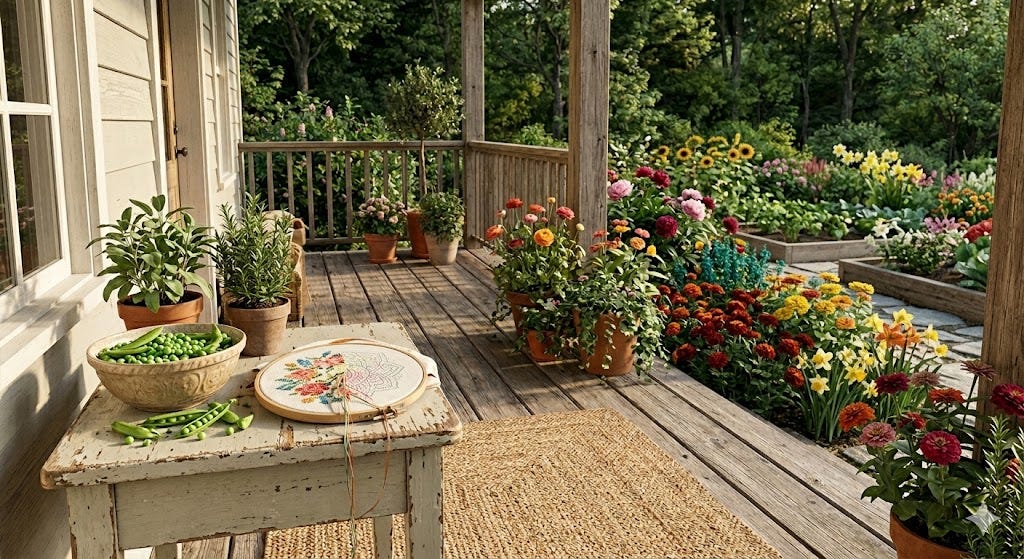
When I cross-stitch, it’s the color, the pattern, and the simplicity that I love. But the rhythm of pulling needle and thread through fabric, I think that’s what I’m aching for when I think of my current project.
Historically, handwork—from the intricate, dutiful alphabets of early samplers to the modern cross-stitched florals taking shape in our laps—have been broadly categorized as “women’s work.” It is a label that was often meant to diminish, to relegate these acts of creation to the background hum of domestic life. But when I look closer at that history, and I see something entirely different. The quiet constraint of stitching gave women an expansive space to listen. With their hands occupied by the repetitive, meditative motion of the needle, they became the silent observers of their own lives, perfectly positioned to absorb the shifting tenor and tone of the household around them.
Kathleen Norris touches on this beautifully in The Quotidian Mysteries, where she explores how the daily, repetitive acts of life—laundry, cooking, the tending of a home—are not distractions from a thoughtful life, but rather the very foundation of it. Similarly, in Wild Witchcraft, Rebecca Beyer elevates these domestic traditions, reminding us that there is a deep, grounding power in the folk magic of the everyday. Tending the land and working with our hands are profound acts of connection.
For a long time, I struggled to reconcile the brainy, intellectual version of myself that I lived so fully for so many years with this quieter, more home-based me.
